Saturday, July 25, 2009

Crash Tutorial on Xinjiang

A particularly high cost government (China) "response"/"crackdown" to rioting by an ethnic minority (the Uighurs, or Uyghurs) is properly big in the news presently.

It is often the case that once tragedy strikes, it becomes too late for us to brush up (or learn for the first time) background to help us understand events in areas outside our general knowledge, because writing becomes too heated, biased, and agenda laden.

These Ürümqi riots that broke out on 5 July 2009 have a great many important implications including historically, religiously, and world-power-relations-wise.

I have assembled one or two articles with good balance and sound information, to help Leaves readers think well in the midst of the flurry of articles that will properly dominate the news in coming days or perhaps longer.

Here is the first, post-raw-breaking-news article that now reports on stage two, the call for an investigation.

clipped from www.mcclatchydc.com

Rights groups press for probe of Uighur deaths in China

WASHINGTON — Three weeks after ethnic violence rocked Urumqi, the capital of China's Xinjiang province, official Chinese news sources are carrying upbeat headlines and photos of smiling Uighurs on the streets, assuring readers that things in western China have returned to normal. On Friday, however, Chinese officials pledged to crack down with an "iron fist" on Uighurs who challenge the authorities.


"We will keep to the policy of launching 'pre-emptive strikes' against and cracking down on enemies with an iron first to curb violent criminality," Nur Berkri, the chairman of the regional government, said Friday, according to Xinhua, the official news agency.

The Chinese government said that 197 people were killed and more than 1,600 injured; Kadeer thinks that the numbers are much higher.


blog it

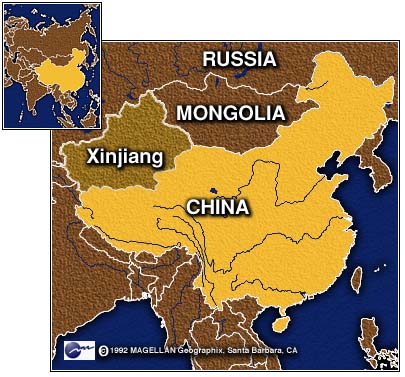
Where is this?

Look here:
and here:


Next I would like to draw your attention to two articles that are quiet in tone, and very helpful to provide background and context to help understand the recent history pertinent to the outbreak of the riots that drew such intense government fire.

The first is from Ariana Eunjung Cha of the Washington Post Foreign Service
URUMQI, China -- When the local government began recruiting young Muslim Uighurs in this far western region for jobs at the Xuri Toy Factory in the country's booming coastal region, the response was mixed.

But others, like Safyden's 21-year-old sister, were wary. She was uneasy, relatives said, about being so far from her family and living in a Han Chinese-dominated environment so culturally, religiously and physically different from what she was accustomed to. It wasn't until a local official threatened to fine her family 2,000 yuan, or about $300, if she didn't go that she reluctantly packed her bags this spring for a job at the factory in Shaoguan, 2,000 miles away in the heart of China's southern manufacturing belt.

The origins of last week's ethnically charged riots in Urumqi, the capital of China's Xinjiang region, can be traced to a labor export program that led to the sudden integration of the Xuri Toy Factory and other companies in cities throughout China.

Uighur protesters who marched into Urumqi's main bazaar on July 5 were demanding a full investigation into a brawl at the toy factory between Han and Uighur workers that left two Uighurs dead. The protest, for reasons that still aren't clear, spun out of control. Through the night, Uighur demonstrators clashed with police and Han Chinese bystanders, leaving 184 people dead and more than 1,680 injured in one of the bloodiest clashes in the country's modern history. Two Uighurs were shot dead by police Monday, and tensions remain palpable.

Both Han Chinese, who make up more than 90 percent of the country's population and dominate China's politics and economy, and Uighurs, a Turkic-speaking minority living primarily in China's far west, say anger has been simmering for decades.

By moving Uighur workers to factories outside Xinjiang and placing Han-run factories in Xinjiang, Chinese officials say, authorities are trying to elevate the economic status of Uighurs, whose wages have lagged behind the national average. But some Han Chinese have come to resent these policies, which they call favoritism, and some Uighurs complain that the assimilation efforts go too far. Uighurs say that their language is being phased out of schools, that in some circumstances they cannot sport beards, wear head scarves or fast as dictated by Islamic tradition, and that they are discriminated against for private and government jobs.


The second is from The New Atlanticist Policy and Analysis Blog,by Griffin Huschke:
With recent violence in China’s western province of Xinjiang, Washington is increasingly ensnared in events dealing with the Uyghur community in China. However, many questions remain about the true goals of this Turkic ethnic group: are they terrorists bent on overturning law and order, or freedom fighters trying to throw off the yoke of a repressive government?

The quick answer is “neither.” Making any generalizations about a population is, of course, difficult: Uyghurs are geographically and culturally diverse. In order to understand the conflict that recently flared in Xinjiang, it is important to note not all Uyghurs see themselves as such. Data gathered by Professor Justin Rudelson show that many Turkmen identify with labels that correspond to their home town or religion as opposed to ‘Uighur.’ Rudelson showed that the concept of a Uyghur ethnicity is often a fuzzy, particularly in the lower and middle classes.

This lack of a Uyghur identity is due to hundreds of years of separation resulting from formidable natural barriers. While those of the same ethnicity had settled around the region, the vast desert and rugged mountains sometimes made travel outside Xinjiang more feasible than travel within the province. Thus, those in the oasis town of Ili have a much stronger historical and cultural connection with the Fergana Valley of Uzbekistan than with their ethnic cousins in Kashgar, China.

How does this help us understand the recent strife in Xinjiang’s capital city of Urumqi? The localized identity, which has existed for thousands of years, may be beginning to shift. While it is too early to begin to discuss a true “pan-Uyghur” identity (as promoted by the World Uyghur Congress, for instance), ethnic Turkic peoples in the region are beginning to feel more isolated from their Han countrymen. In addition to Urumqi, ethnic strife in Shaoguan and other areas of China are making Uyghurs feel more vulnerable and cognizant of their “otherness.” Indeed, violence is becoming increasingly common place. Charles Hutzler in the AP:

Tens of thousands of what the government calls "sudden mass incidents" rock China every year, presumably soaring in number since Beijing stopped releasing the statistic publicly in 2005, when there were 87,000 of them. While loss of life is rarely on the scale of the Xinjiang riot, protesters often vent their rage on public property, burning government offices and cars.

This does not necessarily mean Uyhurs are feeling closer to other Uyghurs—large rifts still exist between Uyghurs. However, these riots indicate that the vast majority of peaceful Uyghurs are likely increasingly uneasy about coexistence with greater China.

At present, only localized and fragmented sentiments of “Uygur-ness” persist, and China still has an opportunity to integrate the Uyghurs into the wider economy and society. However, if Uyghur grievances in Urumqi and elsewhere are not taken seriously, the further growth of “us/them” sentiments may cause more violence in the near future.


I hope these maps and two articles give the kind of background that will allow Leaves readers to recognize the subtlety and complexity of the issues, and not fall prey to easy labels and superficial analyses

Wednesday, July 22, 2009

United Nations Speech Announcement

Counter-Terrorism and International Organizations

July 22, 2009 • 4:00 PM ~ 6:00 PM
Hardin Room • 777 UN Plaza, New York, NY

How the Security Council’s Counter-Terrorism Committee is working to bolster Member
States ability to prevent terrorist acts
Ahmed El-Dawla
Participating in his personal capacity, Judge on Leave

Can Religions Help Counter Terrorism?
Frank Kaufmann
Executive Director, Inter-Religious Federation for World Peace (IRFWP)

The entire announcement is here


Monday, July 20, 2009

Pick our heros with care

In our desperate need to find a champion for the oppressed in Iran, it is tempting quickly to side with any voice for imprisoned voters, especially one that seems to have a chance to make impact.

In such times of need, it is always wise to study a bit, and familiarize or re familiarize ourselves with leading figures in the news.
clipped from www.nytimes.com

Iranian Critic Quotes Khomeini Principles

To establish his own legitimacy, Mr. Rafsanjani evoked his long political history.

Still, it would be wrong to say that Mr. Rafsanjani has suddenly become a proponent of justice, human rights and freedom.

In the summer of 1999, after all, when the government crushed student demonstrations at Tehran University, he delivered a harsh sermon in the same place as he did on Friday. Back then, he blamed “enemies of the revolution” and “sources outside the country” for the unrest. He praised the use of force by the state.

During much of his earlier eight-year presidency, many Iranians were executed, including political dissidents, drug offenders, Communists, Kurds, Bahais, even clerics.

Now, in assailing the government’s handling of last month’s disputed presidential election, Mr. Rafsanjani, a 75-year-old cleric and former president, has cast himself in a new light:

Monday, June 29, 2009

UPDATE 1-US top court rules against city on race promotion


Developments that are reported in this Reuters article has strong bearing on the Sotomayor nomination that was discussed on these pages:

By James Vicini

WASHINGTON, June 29 (Reuters) - The U.S. Supreme Court ruled on Monday that New Haven, Connecticut, discriminated against a mostly white group of firefighters who were denied promotions, overturning a decision by high court nominee Sonia Sotomayor.

Monday, June 22, 2009

Emerging Journalism and the New Iran


Please read the insights of Arnaud de Borchgrave as he describes a remarkable confrontation between the ancien religio-political structures of oppression and the perhaps unintended consequences of social technology.

Monday, June 22, 2009

Twitter has shaken Iran’s regime of aging theocrats to its foundations. The new limitless ability to listen and respond is not only impacting the exchange of ideas on a global scale; it is also impacting national security. Iran is the lodestar.

WASHINGTON, June 22 (UPI) -- ... Twitter is ... propelling both democratic and authoritarian governments through a period of social change that is more profound than anything we have experienced through 5,000 years of recorded history.

The artice is here (<-- click)

Saturday, June 20, 2009

"These things are old": A genuine “theologico-political” phenomenon

Obama represents and epitomizes—perhaps more than any other presidential candidate or political leader in the Western world—such a post-secular as well as post-multicultural and post-identitarian form of politics, whose operating concepts and fundamental categories we have not yet fully gauged.


A friend just forwarded me this article by Hent de Vries of Johns Hopkins Univerity.

I find it very thoughtful and provocative, and would like to recommend it to Leaves readers.


Saturday, June 13, 2009

Obama in Cairo - Reactions

President Obama's speech at Cairo University June 4 was important.

A great amount of analysis already has transpired.

Analysis also will appear in this space following the forthcoming major foreign policy address tomorrow from Prime Minister Binyamin Netanyahu. He will speak at Bar-Ilan University.

Observant readers will see immediately the challenges faced by politicians, and by anyone with responsible concern for the region. Obama is a politician. As such, his speeches are political craft by definition, yet his speech is dubbed a speech to the "Muslim world." Have we ever in our lives seen a politician address him or herself to "the Catholic world," or to the "Buddhist world"?

One sentence in the Obama speech reads:
Experience guides my conviction that partnership between America and Islam must be based on what Islam is, not what it isn't.
Partnership between Islam and America? What are we talking about here? How about a partnership between Hinduism and Russia? Or a partnership between Zoroastrians and the Marshall Islands?

What was the big flash point in the Cairo speech? The issue of settlements. Do settlements have anything to do with Islam?

No

The issue of settlements is a political matter, NOT a religious one. But wait! For Jews (at least for many Jews) it IS a religious matter.

This tiny observation points to the very tip of the complexity and difficulty of the region, and of how to understand and distinguish between words and actions of politicians, and the nature of religions and religious communities.

Tomorrow we will hear another political speech, again, likely to render politics and policy issues into language evoking religious passions, and laced with religious justification and sanction.

These are interesting times. These are two strong and impressive politicians, and we must (as always) pay very close attention. We are enjoined to pray for our leaders.

In the mean time, I have sought for Leaves readers two sample reactions to President Obama's Cairo speech, one from among Muslim thinkers, another from an Israeli perspective.

I sought commentary that is clear and unequivocal, while simultaneously moderate in tone and disposition.

The Center for the Study of Islam and Democracy (CSID) sits on a very progressive horizon of Muslim thinking. Follows are the thoughts of several thinkers convened to analyze and comment upon President Obama's Cairo speech.

After that is a clear flow of Israeli response to the speech. The Wall Street Journal is always reliable to write quietly but forcefully with a conservative lean in its editorial content.

Here are the speakers from the CSID and the Project on Middle East Democracy (POMED) panel:
The Center for the Study of Islam and Democracy (CSID) and the Project on Middle East Democracy (POMED) co-hosted a panel discussion on Thursday, June 4, 2009 entitled "Analyzing Obama's Speech to the Muslim World." The panelists were Geneive Abdo of The Century Foundation, Richard Eisendorf of Freedom House and Will Marshall, of the Progressive Policy Institute. Radwan Masmoudi, President of CSID, moderated the panel.

Masmoudi expressed his apprehension that President Obama would not prominently feature democracy and human rights in his speech. He was pleasantly surprised, however, that democracy was among the speech's main themes. He noted that after twenty years of deterioration of US-Muslim relations due to mistrust, misunderstandings and a lack of information and knowledge on both sides, President Obama's speech set a new course. And while Obama's speech opened hearts and minds in the Muslim world, Masmoudi warned that people in the region would expect concrete, policy-based follow up to his words.

Marshall labeled the speech as "masterful;" noting Obama' unique ability to delicately address complicated issues while simultaneously providing clear solutions in his speeches. As a corollary, he contrasted Bush's use of the imperative voice in communicating with the Muslim world with Obama's deft tone imbued with honesty and respect. He argued that this approach had a disarming effect to those who are inherently distrustful of the United States and burdens its detractors to justify their clichéd beliefs.

Will Marshall at CSIDWhile his overall assessment was positive, Marshall insisted on including three caveats to his praise. First, he worried that Obama's message of reconciliation conceded too much to the al-Qaeda narrative of victimization. Marshall argued that it was not Obama's role to reinforce Muslim feelings of identity politics; rather, it was his duty to debunk them. Second, he noted that the historical animosity between the US and the Muslim world would not change in one speech. He argued that Obama spoke to a tough-minded audience and that radicalism and extremism would not bend to rhetorical sweet-talking. In this vein insisted that values should guide US policy and that America should reap the consequences of such an endeavor. Third, he argued that for Obama's efforts to be seen as a departure from Bush-era policies ignores the real problem of fifty years of America's short-minded policies of allying with expedient allies against Communism and radical Islamism. This track record only reinforced his belief that the United States must align with ordinary people's aspirations against their governments and not step back from promoting democracy.

Geneive Abdo characterized Obama's approach as "evasive" and devoid of any real policy prescriptions. And while he addressed buzzwords such as colonialism and occupation, she argued Obama's approach was not nearly expansive enough. She continued by noting how Obama's rhetorical brilliance raised expectation so high that Iran and al-Qaeda had preemptively issued statements responding to his speech. She continued by critiquing Obama's use of extremism as a foil in his speech. She argued that the debate was already well beyond this dichotomy and that Obama should have used his speech to address the political, economic and social reasons for extremism's regional constituency.

She also noted the originality of using the affluence and freedom of America's Muslim community as an argument in the US's favor. She did not think this argument would be particularly persuasive given the divergence of circumstances among Muslims in the United States and the Middle East. On the War in Iraq, Abdo criticized the president for not apologizing for the invasion and not offering concrete plans for the country. She did admit, however, that he at least repudiated the Bush notion that Iraq was a war of necessity and not one of choice. Abdo also believed that Obama criticized the Palestinians far more than the Israelis in his speech, but did note how the president's tough rhetoric revealed a burgeoning rift between the US and Israel. In summation, she graded the presentation of his remarks highly but felt the substance of the speech was mediocre and that the conflict between the two sides was rooted in policy and not a lack of respect.

Richard Eisendorf noted the choice of Cairo as the venue for the speech as the center of the Arab world and that the diversity of the crowd represented the full breadth of Egyptian public opinion. He then pointed to the loud applause during sections on democracy and human rights as evidence the crowd was not full of Mubarak loyalists. Acknowledging the concerns of his fellow panelists, he asserted that while policy follow up to the speech will be the most important element of his outreach to the Muslim world, the speech did leave a very strong feeling of respect in the way the United States under Obama intends to reach out to the Muslim world. He also pointed to the three D's the administration has heretofore considered the cornerstones of its foreign policy: diplomacy, development and defense. He argued that in the president's speech he appeared to add the fourth 'D' of democracy to the fold.

Eisendorf also highlighted the shift Obama intended to make from Bush policies and how that would affect public opinion in the region. He specifically mentioned the straightforward manner in which Obama addressed the Israeli/Palestinian conflict. He also noted the significance of the president's use of the word 'Palestine' and other key buzzwords. In addition, he believed many in the region would find his rhetoric on this issue insufficient. As a final point, Eisendorf felt Obama finally established his doctrine of 'quiet diplomacy based on mutual respect.'

In his summary statement, Masmoudi noted that while the tone of the speech was largely positive, it only represented the beginning of the administration's engagement with the Muslim world and that implementing the ideas of the speech would be a tremendous challenge. Meeting this challenge, he said, would require the concerted effort both by the domestic American reform constituency as well as positive steps by the Muslim world.


Here is the commentary out of the Wall Street Journal:

Why Israelis Are Cool on the Obama Speech
What's needed is an affirmation of Israel's historical right to exist.

By JUDEA PEARL

A friend asked me to explain why people in Israel, including seasoned peace activists, felt less than buoyant about Barack Obama's speech in Cairo last week.

In theory, Mr. Obama's speech has affirmed everything Israelis have ever hoped for. Peaceful coexistence and mutual acceptance with its Arab neighbors has been the ultimate dream of the Zionist movement since the Balfour Declaration of 1917. So, why not embrace a major U.S. presidential speech that calls for concrete steps to advance that dream?

My friend reminded me of the outburst of joy that seized the Jewish world on Nov. 29, 1947, when the United Nations voted to partition the Biblical land into a Jewish and an Arab state of roughly equal size. There was hardly a dissenting voice then among Israelis. Half a century later, the peace offers that Ehud Barak made to Yasser Arafat in 2000 and that Ehud Olmert made to Abu Mazen in 2009 prove that the idea of a two-state utopia is still firmly lodged in the psyche of most Israelis. Why then weren't Israelis ecstatic over Mr. Obama's speech?

There are two main reasons.

The first stems from crossed signals that are blocking the resumption of peace talks. Palestinians view Israeli settlement construction as the litmus test for Israel's intentions vis-à-vis a future Palestinian state. Israelis view Palestinian textbooks, TV programs and mosque sermons to be the litmus test of Palestinian intentions. A society that teaches its youngsters to negate its neighbor's legitimacy, so the argument goes, cannot be serious about respecting a peace accord as permanent.

Mr. Obama's speech, keenly recognizing the importance of emitting trust-building signals to break the stalemate, had crisp and stern words to say about Israeli settlements but hardly a word about Palestinian denial and incitement. "The United States does not accept the legitimacy of continued Israeli settlements," the president said. "It is time for these settlements to stop."

The hoped-for reciprocal sentence -- "It is time for Palestinian incitements to stop" -- was conspicuously absent. Commentaries on Israeli TV noted disappointedly that not a single demand was addressed to the Palestinian Authority.

This has left many Israelis wondering if the Obama administration is aware of the fierce, subterranean "battle of intentions" that has prevented the peace process from moving forward. In Israel, even the harshest opponent of the settlement movement would not support the emergence of a sovereign neighbor, rocket range away, that is unwilling to invest in education for a lasting peace.

A call for a simultaneous freeze on both Israeli settlements and Palestinian incitement, clad in timetables and monitoring methods, would have invited both sides to an equal honesty test. That test could help jump start the "new beginning" that Mr. Obama called for.

Secondly, Mr. Obama's rationale for Israel's legitimacy began with the Holocaust, not with the birthplace of Jewish history. "The aspiration for a Jewish homeland," he said, "is rooted in a tragic history that cannot be denied." Who else defines Israel's legitimacy that way? Iranian President Mahmoud Ahmadinejad does. Iran sees Israel as a foreign entity to the region, hastily created to sooth European guilt over the Holocaust. Israelis consider this distortion of history to be an assault on the core of their identity as a nation.

An affirmation of "Israel's historical right to exist," based on a 2,000-year continuous quest to rebuild a national homeland, is what the region needs to hear from Mr. Obama. The magic words "historical right" have the capacity to change the entire equation in the Middle East. They convey a genuine commitment to permanence, and can therefore invigorate the peace process with the openness and goodwill that it has been lacking thus far.

I hope that Israeli Prime Minister Benjamin Netanyahu, in a policy speech this Sunday, makes historic recognition an axiomatic part of any peace agreement, and that Mr. Obama backs him up. This would turn Mr. Obama's speech in Cairo into a huge leap forward in the quest for peace and understanding in the region.

Mr. Pearl, a professor of computer science at UCLA, is president of the Daniel Pearl Foundation, founded in memory of his son to promote cross-cultural understanding.